
TRACER is a contract research organisation specialising in radiopharmaceutical development and nuclear imaging studies. Our expertise and network in radiochemistry and clinical research enable us to design and execute clinical studies involving radiopharmaceuticals and radiolabeled drug candidates efficiently.
We provide our sponsors with access to a broad range of radioisotopes, labeling technologies, patient populations, and imaging equipment across multiple clinical sites for both radiotherapy and imaging studies.
But what’s the story behind TRACER, and how did we develop our method?
“Could a drug that binds to a specific target also be used as a tracer to guide tumor-resection surgery in real time?”
The origin of the method
That was the question that started it all for Professor Go van Dam, MD, PhD, then a surgical oncologist at the University Medical Center Groningen (UMCG) and Professor of Surgery at the University of Groningen.

The use of a fluorescent camera during research on fluorescence-guided surgery.
Van Dam developed a method that included a drug labeled for fluorescence optical imaging and the imaging equipment necessary to illuminate the fluorescent signal during surgery. The first in-human fluorescence-guided surgery approach became a reality in 2007 when van Dam, together with the Technical University of Munich and Purdue University, applied fluorescence imaging to a patient with ovarian cancer.
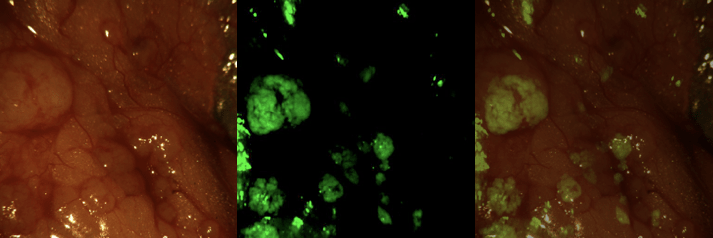
Example of illuminated tumors during fluorescence-guided surgery.
With a publication in Nature Medicine the concept of optical imaging as a visual tool in surgeries started to develop far beyond the borders of medical centers throughout the world. It also helped lay the foundations for something different: the contract research organisation TRACER.
The founding of TRACER
Labeling a drug and visualising its behaviour in patients is valuable not only to surgeons, but also to drug developers. This molecular imaging can provide important information about whether a new drug reaches and engages its intended target. Recognising the value of this approach for the pharmaceutical and biotechnology industries, van Dam founded TRACER in 2017 together with Ari Aminetzah, a life-sciences executive with more than 25 years of international industry experience. Their goal was to accelerate drug development by incorporating molecular imaging into clinical research.
Expanding into radiopharmaceuticals
One of the principal limitations of fluorescence imaging is the relatively shallow penetration depth of the fluorescent signal. The addition of radiolabeling, under the guidance of Maarten Brom, PhD, senior radiochemistry scientist, marked an important step in the development of the TRACER.

Example of nuclear imaging.
By using radiolabeling rather than fluorescent labeling, compounds can be visualised throughout the entire body using positron emission tomography (PET) or single-photon emission computed tomography (SPECT). PET and SPECT offer a big advantage, making it possible not only to identify uptake in a target, but also to quantify the distribution of a compound in target tissue and organs. The data from such nuclear imaging trials can help researchers assess target engagement, biodistribution, pharmacokinetics, dosimetry and potential off-target accumulation.
Your partner in radiopharmaceutical development and imaging studies
Since its foundation, TRACER has expanded its expertise and network across a wide range of radioisotopes, labeling methods and therapeutic areas. We have developed extensive experience in:
- selecting suitable radioisotopes and labeling strategies;
- improving radiolabeling yield and reproducibility;
- managing radiopharmaceutical logistics and handling;
- designing preclinical and clinical imaging studies;
- preparing regulatory submissions for trials involving radiolabeled compounds;
- coordinating and executing multicentre clinical studies; and
- addressing chemistry, manufacturing and controls (CMC) challenges.
TRACER today
Bringing us to the present day, TRACER is a strong partner for radiopharmaceutical development and imaging studies. From managing the complete clinical trial to supporting specific study activities, such as solving CMC issues or reviewing a protocol, we assist drug developers in advancing new (nuclear) medicines.
Contact us today